Why the Fastest-Growing Med Spas Are Investing in Operations, Not Just Marketing
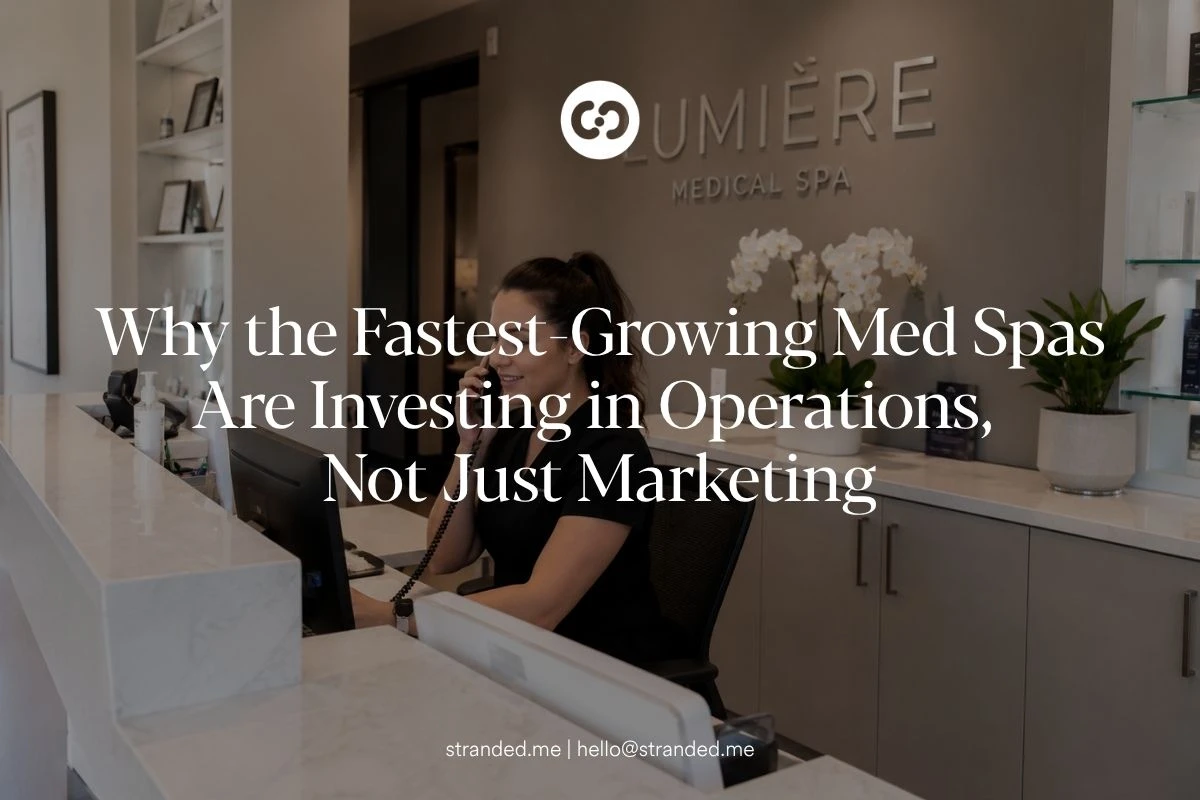
The medical aesthetics industry is experiencing unprecedented growth. Demand for injectables, skin rejuvenation, body contouring, wellness services, and preventative treatments continues to rise as more consumers invest in their appearance and overall well-being. At the same time, competition has intensified. New practices enter the market every month, established clinics continue expanding into multiple locations, and patients have more choices than ever before.
For many practice owners, the first instinct is to invest more heavily in marketing. That often means launching additional Google Ads campaigns, posting more frequently on Instagram, investing in SEO, or running seasonal promotions. While each of these strategies can generate new patient opportunities, they're no longer enough on their own.
The fastest-growing med spas have realized something many practices overlook. Marketing creates demand, but operations determine how much of that demand becomes sustainable revenue. The practices consistently outperforming their competitors aren't necessarily spending the most on advertising - they're building businesses that convert more consultations, retain more patients, create better experiences, and operate more efficiently.
Growth today depends on far more than visibility. It depends on what happens after a prospective patient discovers your practice.
How Do Med Spas Attract More Patients?
Most patient journeys begin long before someone schedules a consultation. Today's consumers spend significant time researching providers before making a decision, comparing websites, reading Google reviews, browsing social media, evaluating before-and-after photos, and often visiting several competing practices before deciding where to book. Throughout that research process, prospective patients are asking themselves a series of important questions:
- Is this practice trustworthy?
- Are the providers experienced?
- Do the treatment results look consistent?
- Does the website feel professional?
- Will scheduling be easy?
- Will I receive exceptional care?
Every piece of marketing either answers those questions or creates uncertainty. That's why successful med spa marketing focuses on building trust throughout the entire patient journey instead of simply generating clicks. An effective patient acquisition strategy typically combines local SEO, Google Ads, high-quality website content, reputation management, educational resources, before-and-after galleries, social media, and conversion-focused landing pages. Each channel serves a different purpose, but together they establish visibility, credibility, and confidence before the first appointment is ever scheduled.
Why Isn't Marketing Alone Enough?
Many practice owners eventually encounter the same frustrating challenge. Marketing improves, website traffic increases, consultation requests rise, yet revenue doesn't grow at the same pace.
This disconnect surprises many owners because it's easy to assume that generating more leads automatically produces more patients. In reality, every marketing campaign hands prospective patients to an operational system. If that system introduces unnecessary friction, conversion rates begin to decline. Patients may encounter:
- Delayed responses to inquiries
- Difficulty scheduling appointments
- Limited online booking options
- Confusing membership information
- Inconsistent communication
- Complicated intake processes
None of these issues are marketing problems, yet every one of them directly affects marketing performance. That's why successful practices evaluate growth differently. Rather than asking, "How do we generate more leads?" they begin asking, "How do we convert more of the opportunities we're already creating?" That shift in thinking often produces greater long-term gains than simply increasing advertising spend.
What Is the Best Marketing Strategy for a Med Spa?
There isn't a single tactic that guarantees consistent growth. Instead, successful practices build integrated marketing systems where multiple channels support one another throughout the patient journey.
Build Long-Term Visibility with SEO
Most aesthetic journeys begin with Google. Prospective patients search for treatments like Botox, dermal fillers, laser resurfacing, or body contouring before they ever contact a provider. Strong med spa SEO helps practices appear during these high-intent searches while building long-term authority within their local market. Unlike paid advertising, SEO continues generating qualified traffic long after content is published, making it one of the highest-return investments for practices focused on sustainable growth.
Capture Immediate Demand with Google Ads
SEO is a long-term strategy, but Google Ads provides immediate visibility for patients actively researching treatments. A well-managed paid search campaign allows practices to appear at the exact moment potential patients are looking for solutions. Rather than competing with SEO, Google Ads complements it. Together they provide both immediate lead generation and long-term organic growth.
Build Trust Before Patients Call
Patients rarely schedule after a single interaction. Instead, they consume multiple forms of content before making a decision. They read blog articles, explore treatment pages, compare before-and-after galleries, watch videos, review testimonials, and evaluate provider credentials.
Every interaction either strengthens trust or weakens it. The practices that consistently convert visitors into consultations understand that education is often the most effective form of marketing because it helps patients feel confident before they ever contact the practice.
Why Is Med Spa Marketing Different from Traditional Marketing?
Medical aesthetics occupies a unique position between healthcare and consumer services. Patients aren't purchasing an impulse product - they're investing in treatments that affect their appearance, confidence, and quality of life. Because of that, trust influences nearly every purchasing decision.
Successful marketing must communicate clinical expertise, safety, professionalism, proven outcomes, and personalized care. Practices that rely exclusively on discounts or promotional messaging often attract price shoppers rather than loyal patients.
Educational marketing creates a fundamentally different relationship. Instead of competing primarily on price, practices compete on expertise, credibility, and patient experience. As competition continues to increase, that distinction becomes one of the most valuable competitive advantages a med spa can build.
How Can a Med Spa Compete with Larger Clinics?
Many independent med spas assume larger organizations possess an insurmountable advantage because they have larger marketing budgets. In reality, smaller practices often compete more effectively than they realize. Independent clinics frequently offer stronger provider relationships, more personalized patient experiences, faster decision-making, greater flexibility, deep local community connections, and specialized expertise. Strategic marketing amplifies those strengths instead of trying to replace them.
Rather than attempting to outspend larger competitors, successful practices focus on becoming the most trusted provider within their market. That's one reason many growing practices partner with specialists who understand aesthetic medicine rather than general marketing. A strategic Med Spa Marketing program aligns SEO, paid media, content strategy, reputation management, and patient acquisition into a unified growth strategy instead of treating each marketing channel as an isolated tactic.
Growth Creates New Operational Challenges
Ironically, success often creates the next obstacle. As practices grow, complexity grows with them. More providers mean more schedules to manage. Additional treatment offerings require greater coordination. Membership programs introduce recurring billing and communication, while multiple locations increase administrative demands and operational complexity.
Hiring new staff creates another challenge: maintaining consistency across every patient interaction. Without well-designed systems, growth can quickly strain both employees and the patient experience. Many owners eventually discover their biggest obstacle is no longer attracting new patients. It's creating operational systems capable of supporting continued growth without sacrificing efficiency, consistency, or the high-quality experience patients expect.
Why the Patient Experience Has Become a Competitive Advantage
Many practice owners think of marketing as the process of generating leads. Patients don't see it that way. They don't separate your business into marketing, scheduling, billing, customer service, and operations. To them, it's all one continuous experience that either builds confidence or creates doubt.
A typical patient journey might look like this:
- Search Google for a treatment.
- Visit your website.
- Read online reviews.
- Browse before-and-after galleries.
- Compare providers.
- Schedule a consultation.
- Receive appointment reminders.
- Complete treatment.
- Schedule follow-up care.
- Return for future services.
Every touchpoint influences how patients perceive your practice. If the first half of the experience is exceptional but booking becomes frustrating, the entire journey suffers. On the other hand, outstanding operations reinforce the trust your marketing worked so hard to establish. That's why successful med spas increasingly evaluate the entire patient journey rather than focusing exclusively on lead generation.
From Marketing Funnel to Patient Journey
Many practice owners think of marketing as the process of generating leads. Patients don't see it that way. They don't separate your business into marketing, scheduling, billing, customer service, and operations. To them, it's all one continuous experience that either builds confidence or creates doubt.
A typical patient journey might look like this:
- Search Google for a treatment.
- Visit your website.
- Read online reviews.
- Browse before-and-after galleries.
- Compare providers.
- Schedule a consultation.
- Receive appointment reminders.
- Complete treatment.
- Schedule follow-up care.
- Return for future services.
Every touchpoint influences how patients perceive your practice. If the first half of the experience is exceptional but booking becomes frustrating, the entire journey suffers. On the other hand, outstanding operations reinforce the trust your marketing worked so hard to establish. That's why successful med spas increasingly evaluate the entire patient journey rather than focusing exclusively on lead generation.
Why Technology Has Become a Strategic Growth Investment
Not long ago, most med spas viewed practice management software as little more than an administrative necessity. It handled scheduling, payments, and patient records, but it wasn't considered part of the overall growth strategy. That mindset is changing.
Today's highest-performing practices recognize that every interaction after a prospective patient clicks an ad or visits a website influences whether that person becomes a loyal patient. The technology supporting those interactions has become just as important as the marketing that generated the opportunity.
Consider a common scenario. A prospective patient discovers your practice through Google, explores your website, reads reviews, and decides they're finally ready to book. Then they discover they must call during business hours, wait on hold, leave a voicemail, or complete paperwork when they arrive.
Nothing about the clinical care has changed, yet the experience introduces unnecessary uncertainty before the patient has even stepped inside your practice. Now imagine a different experience.
The patient schedules online in less than two minutes. Their confirmation arrives immediately, digital paperwork is completed before the appointment, and automated reminders keep everything organized. After treatment, personalized follow-up communication encourages them to schedule their next visit while recommended skincare products are only a few clicks away.
Neither practice necessarily spent more on advertising. Yet one creates significantly more confidence from beginning to end. That's why technology is increasingly viewed as a strategic growth investment rather than simply an operational expense.
Integrated Platforms Help Practices Scale More Efficiently
Growth inevitably creates complexity. Adding providers, expanding treatment offerings, introducing memberships, selling skincare online, or opening additional locations all increase the administrative demands placed on your team. Without the right systems, staff members spend more time managing software than serving patients.
Many practices discover their technology stack has evolved organically over time. Scheduling exists in one platform, email marketing in another, memberships require separate software, reporting happens inside spreadsheets, and online forms connect through multiple third-party integrations. While each solution may perform its individual task well, they rarely provide a complete view of the business. The result is duplicated work, inconsistent communication, fragmented reporting, and unnecessary administrative burden.
Integrated practice management platforms solve this problem by bringing core operational functions into one ecosystem. Rather than switching between multiple applications, teams can manage scheduling, payments, patient communication, memberships, reporting, and day-to-day workflows from a centralized platform. The benefits extend far beyond convenience. Practices often see:
- Faster online scheduling
- Fewer appointment no-shows
- More consistent patient communication
- Simpler membership management
- Better reporting and business intelligence
- Reduced administrative workload
- Improved patient retention
- A more consistent experience across every location
These operational improvements don't replace great marketing. They make great marketing significantly more effective.
Why Marketing and Operations Should Never Be Separate Conversations
Traditionally, marketing agencies have focused on generating more leads while software companies focused on improving internal operations. The fastest-growing med spas recognize these aren't separate conversations - they're two parts of the same growth strategy. Every patient acquired through Google Ads, SEO, referrals, email marketing, or social media eventually enters an operational system. That system either reinforces the confidence created through marketing or gradually erodes it.
Imagine two practices running identical marketing campaigns. Each generates one hundred consultation requests every month. One relies on manual scheduling, inconsistent follow-up, and disconnected software.
The other delivers online booking, automated communication, streamlined check-in, personalized follow-up, and a seamless experience from start to finish. Which practice converts more consultations? Which earns better reviews?
Which generates more referrals? Which retains patients longer? The difference isn't the advertising budget.
It's everything that happens after the click. Marketing creates opportunity. Operations determine how much value those opportunities ultimately produce.
Platforms Like Boulevard Reflect Where the Industry Is Going
Across the aesthetics industry, more practices are moving toward unified operating platforms that connect every stage of the patient journey. Rather than treating scheduling, communication, memberships, reporting, and payments as separate systems, they're bringing these functions together into a single operational foundation. Boulevard reflects this broader shift in how successful practices operate. By helping centralize scheduling, patient communication, memberships, payments, reporting, and other essential workflows, integrated platforms make it easier for practices to deliver the kind of modern experience today's patients expect.
Patients benefit from a more intuitive and convenient experience. Staff spend less time on repetitive administrative work. Practice owners gain greater visibility into scheduling, revenue, memberships, and overall business performance.
Most importantly, platforms like BLVD help ensure the patient experience aligns with the expectations established by a practice's marketing. That's where the real opportunity exists. Marketing generates awareness.
Operations build confidence. Exceptional patient experiences create loyalty. When those three elements work together, practices don't simply acquire more patients. They build stronger businesses that are better equipped to grow sustainably, adapt to changing patient expectations, and compete in an increasingly sophisticated market.
Sustainable Growth Starts With Strong Foundations
The med spa industry is evolving rapidly. Patients have higher expectations. Competition continues to increase.
Technology is transforming how practices operate. Success today requires more than simply attracting attention. It requires creating a patient experience that builds confidence from the first Google search through every follow-up appointment.
The practices leading the industry aren't relying on one marketing tactic or one software platform to drive growth. They're building complete business systems where marketing, operations, technology, and patient experience work together. When those pieces align, advertising becomes more effective, teams become more efficient, and patients are more likely to return, refer friends, and become long-term advocates for your practice.
At Stranded, we help med spas build those systems. Our approach goes beyond running Google Ads or improving search rankings. We develop growth strategies that connect every stage of the patient journey, helping practices attract qualified patients while strengthening the operational foundation needed to support sustainable growth.
Whether you're launching a new med spa, expanding into additional locations, or looking to improve the performance of your existing marketing, taking a strategic approach can help you build a stronger, more resilient business. Learn how Stranded's Med Spa Marketing services can help your practice increase visibility, attract more qualified patients, and create a marketing strategy built for long-term growth.
Frequently Asked Questions
What is the best marketing strategy for a med spa?
The most effective med spa marketing strategy combines multiple channels that work together. SEO builds long-term visibility, Google Ads captures high-intent searches, reputation management strengthens credibility, and educational content helps patients make informed decisions. The strongest results come from treating marketing as a complete patient acquisition system rather than relying on a single tactic.
Do med spas need SEO or Google Ads?
Most successful practices invest in both. Google Ads can generate immediate leads from patients actively searching for treatments, while SEO helps your practice rank organically for valuable search terms over time. Together, they create a balanced strategy that supports both short-term growth and long-term visibility.
How much should a med spa spend on marketing?
There is no universal budget because every practice has different goals, markets, and competition levels. Instead of focusing solely on marketing spend, owners should evaluate patient acquisition costs, conversion rates, patient lifetime value, and return on investment. A strategic marketing plan prioritizes profitable growth rather than simply increasing traffic.
What does a med spa marketing agency do?
A specialized med spa marketing agency helps practices attract qualified patients through SEO, Google Ads, content marketing, website optimization, reputation management, and patient journey strategy. Unlike a general marketing agency, an aesthetics-focused partner understands how patients research treatments, compare providers, and ultimately choose where to book.
How do new med spas attract their first patients?
New practices should begin by establishing credibility within their local market. That includes optimizing their Google Business Profile, building a professional website, investing in local SEO, generating patient reviews, creating educational content, and running targeted Google Ads. Building trust early helps create sustainable patient growth.
How long does SEO take for a med spa?
SEO is a long-term investment rather than an immediate solution. While some improvements may become visible within a few months, meaningful growth often takes six to twelve months depending on competition, website authority, and the quality of your content strategy. Practices that consistently publish valuable content and optimize their websites generally achieve the strongest long-term results.