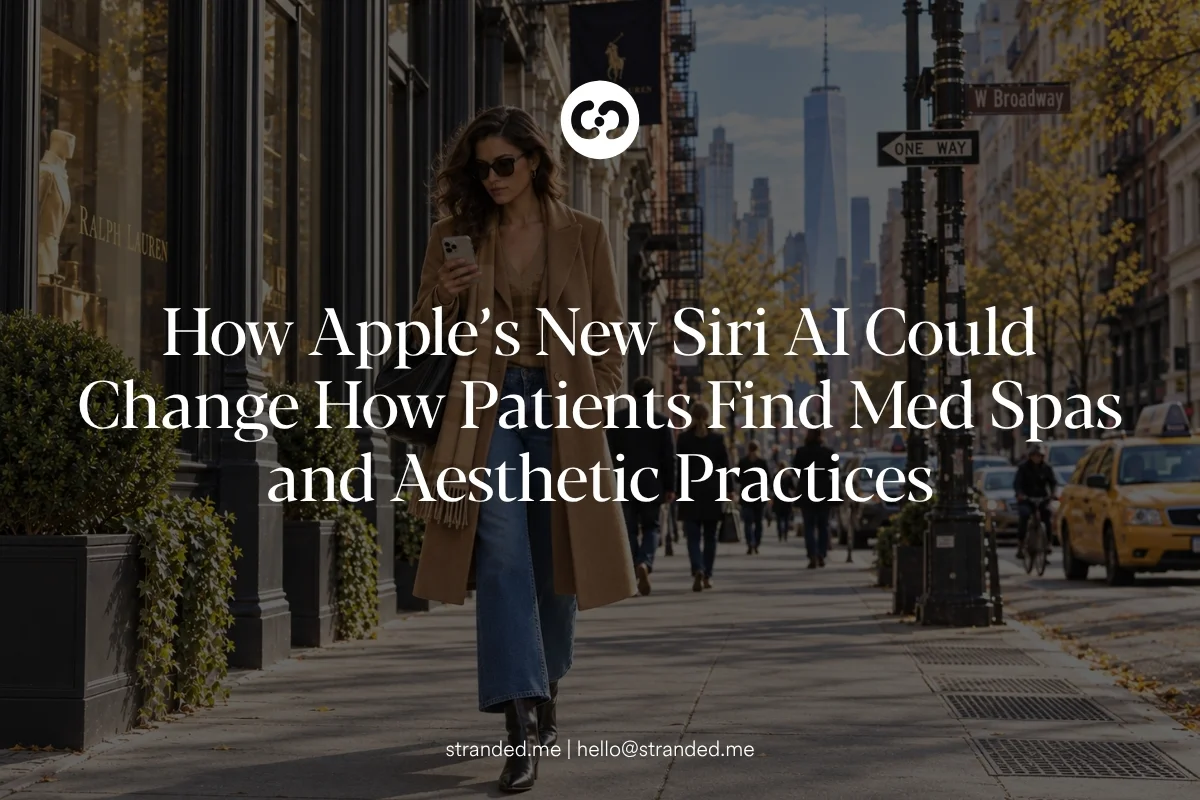
How Apple’s New Siri AI Could Change How Patients Find Med Spas and Aesthetic Practices
For years, attracting a new aesthetic patient often started with a Google search.
Someone interested in Botox might search “Botox near me.” A patient concerned about acne scars might search “best acne scar treatment.” Someone considering facial rejuvenation might compare several med spas, read reviews, browse before-and-after photos, and eventually book a consultation.
That behavior is beginning to change.
Apple has introduced a new generation of Siri designed to function less like a voice-command tool and more like a conversational AI assistant. Siri AI can access current information from the web, understand follow-up questions, analyze visual information, and provide more complete answers instead of simply directing users toward search results.
Behind the scenes, Apple has also partnered with Google to build its newest generation of Apple Foundation Models using technologies developed for Google’s Gemini models.
For med spas and aesthetic practices, the technology underneath Siri is less important than the shift happening in front of the patient.
Search is becoming a conversation.
That could have significant implications for med spa SEO, local search visibility, reputation management, content strategy, and patient acquisition.
How Could Siri AI Change the Way Patients Find Med Spas?
Siri AI could allow prospective patients to research aesthetic treatments and providers through natural conversations instead of a series of individual searches.
Consider how someone might research lip filler today.
They may search:
- lip filler near me
- best lip filler injector
- how much does lip filler cost
- lip filler before and after
- how long does lip filler last
- best med spa for natural lip filler
Each search creates another opportunity for a practice to appear.
An AI-driven patient journey could look very different.
A prospective patient might simply ask:
“What’s the best treatment for adding subtle volume to my lips without looking overdone?”
Then:
“How long does it last?”
Then:
“What does it usually cost?”
And finally:
“Find highly rated providers near me that specialize in natural-looking results.”
Instead of starting over with every search, the patient can continue the same conversation.
That changes what aesthetic practices need to optimize for.
AI Search Is Moving Beyond Traditional Keywords
Keywords still matter. They help search engines understand what a page is about and connect it with relevant searches.
But conversational AI places greater emphasis on meaning, context, expertise, and relationships between information.
A traditional med spa SEO strategy might target a phrase such as:
RF microneedling Scottsdale
An AI assistant may need to answer much more complex questions:
- What treatment works for acne scars and enlarged pores?
- Is RF microneedling better than traditional microneedling?
- How much downtime should I expect?
- Am I a good candidate?
- What providers near me offer the treatment?
- Which practice has strong reviews?
- Who specializes in treating my concern?
The winning content is therefore unlikely to be the page that simply repeats “RF microneedling Scottsdale” most often.
It is more likely to come from a digital presence that clearly establishes what the practice does, who it serves, where it operates, what its providers know, and why patients trust it.
Will Siri Recommend Your Med Spa?
That may become one of the most important marketing questions aesthetic practice owners ask.
AI search engines and assistants need enough reliable information to understand a business before they can confidently surface it in an answer.
For a med spa, those signals can exist across many parts of the web.
They may include:
- Your website
- Treatment pages
- Provider biographies
- Google Business Profile
- Patient reviews
- Local business listings
- Editorial coverage
- Social profiles
- Before-and-after content
- Educational articles
- Frequently asked questions
- Structured website data
No single optimization guarantees that Siri, Gemini, ChatGPT, Google AI Overviews, or another AI system will recommend a particular practice.
The broader objective is to create a digital footprint that is clear, consistent, useful, and authoritative.
This is where traditional SEO and emerging AI search optimization increasingly overlap.
Does AI Search Make Med Spa SEO Less Important?
No. If anything, AI search makes strong SEO fundamentals more valuable.
AI systems still need information.
When a practice publishes detailed treatment information, maintains accurate business listings, earns strong reviews, builds authoritative content, and clearly communicates its expertise, it gives search systems more information to understand.
The goal of Med Spa Marketing is therefore expanding beyond earning a position in traditional Google results.
A modern visibility strategy needs to help a practice become discoverable wherever patients ask questions.
That includes Google Search and Maps, but increasingly also AI Overviews, ChatGPT, Gemini, Siri, and whatever discovery platforms emerge next.
Treatment Pages May Become Even More Valuable
A common mistake in aesthetic clinic marketing is treating individual service pages like digital brochures.
A page might contain a short description of Botox, a few benefits, and a booking button.
That may no longer be enough.
Strong treatment pages should answer the questions patients ask throughout the decision-making process.
For example, a Botox page could address:
- What Botox treats
- How Botox works
- Who makes a good candidate
- What areas can be treated
- How long results may last
- When results typically appear
- Expected downtime
- Botox versus other neuromodulators
- What a consultation involves
- Frequently asked patient questions
This type of content serves two audiences simultaneously.
It helps patients make informed decisions while also giving search engines and AI assistants clearer information about the practice’s expertise.
Concern-Based Content Could Become a Bigger Patient Acquisition Opportunity
Patients do not always know which treatment they need.
They know what bothers them.
Someone may notice loose skin along the jawline without knowing whether they should research RF microneedling, ultrasound-based treatments, injectables, biostimulators, or surgery.
Another person may want to improve acne scarring without understanding the differences between lasers, microneedling, chemical peels, and combination treatments.
That creates an important opportunity for aesthetic practices.
Instead of only building pages around treatment names, practices should also create high-quality educational content around patient concerns.
Examples include:
- Best treatments for acne scars
- Options for improving skin laxity
- Treatments for facial volume loss
- How to improve uneven skin texture
- Treatments for sun damage
- Options for a more defined jawline
- How to reduce fine lines without surgery
These pages better reflect how patients naturally ask questions.
They also create bridges between early-stage research and individual treatment pages.
Reviews Could Become Even More Important in AI-Powered Discovery
A patient asking an AI assistant to find a med spa is unlikely to care only about distance.
They may ask for the “best,” “highest rated,” “most experienced,” or “most trusted” provider.
That makes reputation a critical component of digital visibility.
Reviews give prospective patients information about the experience beyond what the practice says about itself. They can reveal patterns involving staff, consultations, results, communication, atmosphere, and patient satisfaction.
For practice owners, reputation management should not be treated as a separate activity from SEO.
Reviews influence trust at the exact moment patients are comparing providers.
As AI assistants become more involved in those comparisons, having a strong and consistent reputation across the web becomes even more valuable.
Local SEO Still Matters in an AI Search World
One of the biggest misconceptions about AI search is that traditional local SEO will somehow disappear.
Patients still need a real provider in a real location.
Someone asking Siri about facial balancing may eventually need an injector within 15 miles. Someone searching for laser resurfacing may prefer a dermatologist nearby. A prospective patient may want a highly rated med spa in a specific neighborhood.
That means location information remains critical.
Practices should maintain accurate and consistent information about:
- Business name
- Address
- Phone number
- Hours
- Service areas
- Treatment offerings
- Providers
- Reviews
- Location-specific services
City and location pages can also play an important role when they contain meaningful local information rather than duplicated copy with the city name changed.
AI does not eliminate local intent. It changes how patients express it.
Visual Search Could Be Particularly Important for Aesthetics
The implications extend beyond text search.
Apple is expanding Siri’s ability to understand visual information, including content viewed through the camera or displayed on a user’s screen.
That is especially relevant to aesthetics, where discovery is already highly visual.
Patients routinely encounter treatments through:
- Instagram Reels
- TikTok videos
- Before-and-after photography
- Provider content
- Skincare products
- Celebrity treatments
- Screenshots
- Online advertisements
A patient who sees an unfamiliar treatment may increasingly be able to ask an AI assistant about what they are looking at without leaving that experience.
Imagine someone seeing a screenshot of a before-and-after result and asking:
“What treatment could produce a result like this?”
That question could lead to additional research about the procedure, recovery, cost, and eventually providers.
For aesthetic practices, high-quality imagery, descriptive image information, useful surrounding content, and a strong brand presence may become even more connected to search visibility.
What Should Med Spas Do to Prepare for AI Search?
There is no single “Siri optimization” switch a med spa can turn on.
Instead, practices should strengthen the underlying signals that help both humans and machines understand their expertise.
1. Build Comprehensive Treatment Pages
Give each important treatment enough information to answer real patient questions.
Avoid thin service pages created only to target a keyword.
2. Create Content Around Patient Concerns
Build educational resources addressing what patients are trying to improve, not just the procedures you sell.
This expands visibility earlier in the patient journey.
3. Strengthen Local SEO
Maintain accurate business information, location pages, Google Business Profile data, reviews, and other local signals.
AI discovery still needs to understand where your practice operates.
4. Develop Provider Authority
Detailed provider biographies, credentials, specialties, professional experience, and educational content help establish who is behind the practice.
In aesthetics, trust in the provider often influences the booking decision as much as the treatment itself.
5. Build a Consistent Review Strategy
Encourage satisfied patients to share authentic experiences.
A steady stream of credible reviews gives both patients and search platforms stronger signals about the practice.
6. Connect Your Content
Use internal links between concern pages, treatment pages, provider pages, location pages, and educational articles.
A well-structured website makes relationships between information easier to understand.
7. Think Beyond Google Rankings
Continue monitoring traditional organic rankings, but broaden the definition of search visibility.
The question is no longer only, “Where do we rank?”
It is increasingly:
“Can the platforms our patients use understand our practice well enough to surface us?”
AI Search Makes Marketing Strategy More Important, Not Less
The rise of AI assistants does not mean aesthetic practices should chase every new platform or abandon proven channels.
It means the patient journey is becoming more fragmented.
A prospective patient might first encounter a treatment on Instagram, research the procedure through Siri, check Google reviews, visit the practice website, browse before-and-after photos, leave, encounter a retargeting ad, and finally book.
Successful aesthetic clinic marketing requires those touchpoints to reinforce one another.
That is why effective aesthetic practice marketing requires more than isolated SEO, paid ads, social media, or content.
It requires a growth strategy built around how patients actually make decisions.
The Next Patient Journey Is Already Taking Shape
Apple’s new Siri is another signal that patient discovery is moving beyond a simple list of search results.
The practices positioned to benefit will not be those chasing a temporary AI optimization tactic. They will be the ones building strong digital authority across their websites, local presence, educational content, reviews, providers, and patient experience.
The objective is simple: make your practice easy to find, easy to understand, and easy to trust wherever patients are researching.
Stranded helps med spas and aesthetic practices build integrated growth strategies across SEO, paid media, creative, content, and the complete patient journey.
Frequently Asked Questions
Will Siri AI replace Google Search for med spa patients?
Siri AI is unlikely to eliminate traditional Google searches, but it could capture more patient research queries. Practices should prepare for a search environment where patients move between search engines, Maps, social media, AI assistants, reviews, and practice websites.
How can my med spa appear in Siri AI results?
There is no guaranteed method for appearing in Siri responses. Strong SEO, accurate local information, useful treatment content, provider authority, reviews, and a consistent online presence can make your practice easier for search systems to understand and evaluate.
Does my med spa need AI SEO?
Med spas should focus first on excellent SEO fundamentals rather than chasing AI-specific tricks. Clear website structure, comprehensive content, local authority, strong reputation signals, and credible expertise support visibility across both traditional and AI-powered search experiences.
Is local SEO still important for med spas?
Yes. Most aesthetic treatments require a patient to visit a physical practice, so geography remains central to patient acquisition. Local SEO helps search platforms understand where your practice operates, what services it provides, and how relevant it is to nearby patients.
What type of content should a med spa create for AI search?
Create content that directly answers patient questions about treatments, concerns, candidacy, downtime, expected results, alternatives, costs, and provider expertise. Concern-based guides and detailed treatment pages are especially useful because they match conversational search behavior.
Will reviews affect whether AI recommends a med spa?
Reviews can contribute important reputation and patient-experience information online. While no practice can control how an AI assistant chooses recommendations, strong and consistent reviews help establish the credibility patients look for when comparing aesthetic providers.